Custom Button Up Shirts Little Rock: Fabric, Fit, and Stitching
Most people picking out staff shirts start with color and size. Fabric comes up last, if at all.
That order is backwards. Fabric decides how the shirt wears through a workday, how it holds a stitched logo, and whether it still looks right after forty washes. Color is the easy part.
This covers the four weaves you will actually be choosing between, how each one takes embroidery, and what to think about before ordering for a whole team.
Quick Summary
Button up shirts come in four common weaves, and each one behaves differently under an embroidery needle. Oxford holds a heavy logo well. Poplin shows every stitch, good and bad. Twill hides wrinkles. Flannel needs a topping so the stitches do not sink. Custom Shirt Hoodies handles all four in-house at Park Plaza.
Button Up or Polo
Quick version, then moving on.
A button up is woven. The threads cross over and under in a fixed grid, so the fabric has almost no stretch and holds a crisp shape. That is why it reads formal.
A polo is knit. The yarn loops through itself, which is why it stretches, breathes, and moves with you. That is why it reads casual and works better for active roles.
If your team spends the day on ladders or on a retail floor, custom polo shirts in Little Rock are the better starting point. If they sit in offices, meet clients, or work a front desk, keep reading.
Oxford
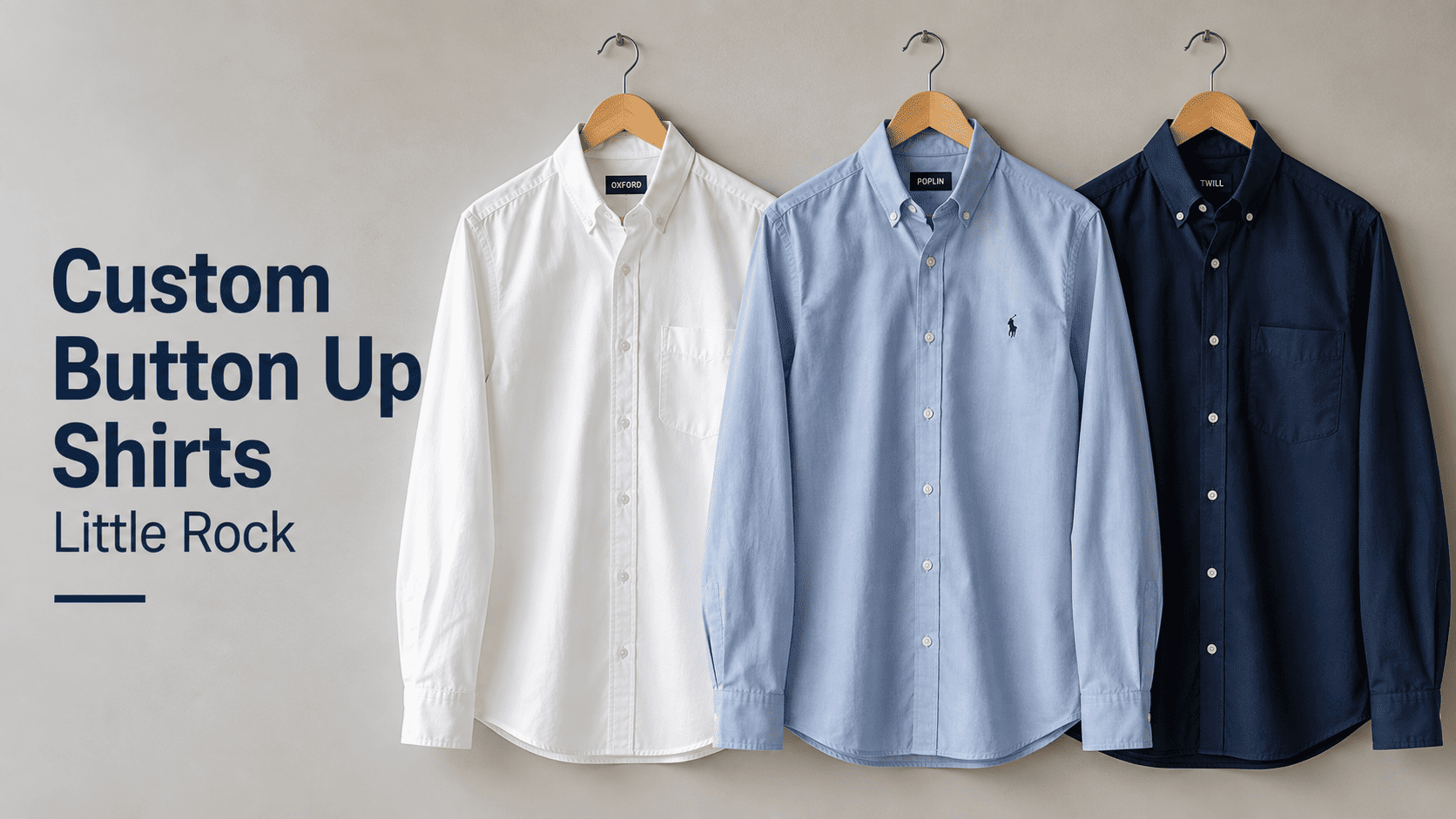
Oxford is a basketweave. Two or more threads get grouped together and woven as a unit, which gives the fabric a visible texture and noticeably more heft than a standard shirting.
It is durable. It softens as it ages instead of wearing out. It is also the most forgiving fabric on this list for embroidery, because the weight and texture give the needle something substantial to anchor into. A dense logo with a high stitch count sits flat on oxford without puckering the fabric around it.
The tradeoff is formality. Oxford reads business casual, not business formal. It is the shirt for a firm with a relaxed dress code, not a shirt for a boardroom.
Best for: sales teams, real estate, offices with a relaxed dress code, anyone wanting a shirt that survives daily wear.
Poplin
Poplin is a plain weave, one thread over one thread, tightly spun. The result is smooth, lightweight, and slightly cool to the touch.
This is the classic dress shirt fabric. It presses to a sharp line and looks crisp under a jacket.
For embroidery, poplin is the least forgiving of the four. The weave is fine and the fabric is thin, so a heavy logo can pull and pucker the surface if the backing is not right. It also shows everything. A clean, well-digitized logo looks excellent on poplin. A sloppy one has nowhere to hide.
Poplin also wrinkles. If your staff cannot press shirts regularly, that shows too.
A useful side-by-side of poplin, twill, and oxford weaves breaks down how each behaves through a workday if you want to compare before deciding.
Best for: client-facing professional roles, front desk staff, anyone who needs the shirt to look formal.
Twill
Twill runs on a diagonal. You can see the ridge line if you look closely at the fabric.
That diagonal structure does two useful things. It resists wrinkling better than poplin, and it drapes softly instead of holding a stiff shape. A twill shirt worn all day still looks presentable at five o’clock.
For embroidery, twill sits between oxford and poplin. Enough body to support a logo, smooth enough to show detail. The diagonal weave can slightly skew very fine lines, so small text is worth checking on a sample stitch first.
Best for: staff who move a lot, service techs in customer-facing roles, restaurant front-of-house, anyone who cannot press a shirt every morning.
Flannel
Flannel is brushed. After weaving, the surface gets raised with fine wire brushes, which creates the soft nap that makes it warm.
For workwear in cold months, flannel is a practical pick. For embroidery, it needs an extra step. That raised nap will swallow stitches if nothing sits on top of the fabric during stitching, so a dissolvable topping goes down first to hold the surface flat. Without it, a logo looks fuzzy and the edges blur.
That is a shop-side detail. You do not need to request it. But it is why flannel logos should always get a sample stitch before a full run.
Best for: outdoor crews, contractors, seasonal staff apparel, anyone working through an Arkansas winter.
How the Weaves Compare
| Fabric | Weight | Wrinkle Resistance | Embroidery Difficulty | Reads As |
| Oxford | Medium-heavy | Moderate | Easy | Business casual |
| Poplin | Light | Low | Demanding | Business formal |
| Twill | Medium | High | Moderate | Business casual |
| Flannel | Heavy | High | Needs topping | Workwear |
Collars, Cuffs, and Plackets
These details are small, and they change how a shirt reads.
Point collar. Narrow spread, conservative. The default for most business shirts.
Spread collar. Wider gap between the points. Slightly more formal, pairs better with a tie.
Button-down collar. Points fasten to the shirt. The most casual option, standard on oxford.
Barrel cuff. One or two buttons. The everyday cuff.
French cuff. Folds back, needs cufflinks. Rarely appropriate for staff uniforms.
Standard placket. The strip of fabric down the front where the buttons sit. Visible, structured.
Hidden placket. Buttons concealed behind a fabric flap. Cleaner front, more formal.
For staff apparel, point or button-down collars with a barrel cuff covers nearly every situation. The construction details of a dress shirt go deeper if you want the full breakdown of what varies between styles.
Fit Across a Mixed Staff
This is where uniform orders go wrong more often than fabric or logo choice.
Three fits exist. Slim cuts close through the chest and waist. Classic leaves room through the body. Relaxed adds more room still, usually in work-oriented shirts.
If you order slim for a whole team, some people will be uncomfortable and it will show in how they wear the shirt. Sleeves get rolled, buttons get left open, and the uniform stops looking uniform.
What works better:
- Offer two fits, slim and classic, same fabric and same logo
- Collect neck and sleeve measurements rather than guessing from t-shirt sizes
- Order a sample in a middle size and have a few people try it before the full run
- Account for the fact that people’s sizes change between seasons
The shirt everyone actually wants to wear is the one that gets worn correctly.
Embroidery on Woven Fabric
Woven fabric behaves differently under a needle than knit.
Knit stretches, so it needs a cutaway backing that stays permanently to keep the logo from distorting as the fabric moves. Woven fabric does not stretch much, so a tearaway backing is usually enough, and it gets removed after stitching. That leaves a cleaner finish on the inside of the shirt.
Fabric weight sets the ceiling on stitch density. A dense, heavily filled logo works on oxford or twill. On lightweight poplin, that same logo can pull the fabric and create a visible ripple around the edges. When that risk exists, the fix is either lowering the stitch density or moving to a slightly heavier fabric.
Thread choice matters too. Polyester thread resists bleach and holds color longer, which is worth specifying for restaurant or healthcare staff who wash shirts hard. Rayon has more sheen and looks better on formal shirts that get gentler treatment.
The mechanics of stitching into fabric explain why backing and density interact the way they do, if that level of detail is useful for your order.
For the full stitching service including hats, jackets, and bags, embroidery in Little Rock AR covers what else can carry the same logo.
Reordering Next Season
Most uniform programs are not one order. They are an order now and another one in eight months when new people join or shirts wear out.
Things that break consistency between batches:
Fabric lots shift. Two orders of the same shirt in the same color, placed a year apart, can differ slightly in shade. Ordering extras up front avoids this.
Blank styles get discontinued. A shirt available this year may not exist next year. If a style matters to you, buy the buffer now.
Logo files drift. If your logo gets updated and the stitch file does not, batch two will not match batch one.
Placement measurements get lost. Left chest, three and a half inches wide, four inches down from the shoulder seam. Write it down. Reorders should match without re-measuring.
Keeping a documented uniform reorder system solves most of this. At minimum, keep the garment style number, the color code, the thread colors, and the placement measurements in one file.
Once your logo is digitized and on record, reorders skip straight to stitching. For pricing across larger runs, bulk orders in Little Rock covers how quantity affects the total.
What to Bring
- Logo file. Vector preferred, high-resolution image acceptable.
- Fabric preference. Oxford, poplin, twill, or flannel. Or describe the setting and let the shop recommend.
- Fit needs. Slim, classic, or both.
- Size list. Neck and sleeve measurements if you have them.
- Placement. Left chest is standard. Specify anything different.
- Quantity and deadline.
Key Takeaways
- Oxford is the most forgiving fabric for embroidery. Poplin is the least.
- Twill resists wrinkles better than poplin and takes a logo cleanly.
- Flannel needs a dissolvable topping so stitches do not sink into the nap.
- Woven fabric uses tearaway backing. Knit needs cutaway.
- Offering two fits across a staff produces a better-looking uniform than forcing one.
- Document your garment style, color code, thread colors, and placement for consistent reorders.
Where to Get Custom Button Up Shirts in Little Rock
Custom Shirt Hoodies handles embroidery in-house at Park Plaza Shopping Center in Little Rock. Digitizing, sample stitching, and the final run happen in the same shop, so the person taking your order is the one accountable for how it comes out.
You approve the sample before the machine touches your shirts, and you check the finished pieces before you pay. If a thread color or placement is off, it gets caught in the shop rather than after a box arrives.
Walking in also lets you feel the fabric before committing. The difference between poplin and twill is obvious in hand and invisible in a photo.
Address: Park Plaza Shopping Center, Little Rock, AR
Hours: Walk in any day, no appointment needed.
The shop serves North Little Rock, Sherwood, Conway, Benton, Bryant, Maumelle, Jacksonville, and Cabot.
Related options include custom work shirts in Little Rock for branded workwear, custom dress shirts in Little Rock for the broader business apparel range, and custom embroidered sweatshirts for cold-weather layers over the same uniform.
Frequently Asked Questions
Which button up fabric works best for embroidered logos?
Oxford. The basketweave gives it enough weight and texture to anchor a dense logo without puckering. Twill is a close second. Poplin works but needs correct backing and a moderate stitch density because the fabric is light and shows everything.
Can I get flannel work shirts embroidered?
Yes. Flannel has a raised nap that will bury stitches, so a dissolvable topping goes down before stitching to hold the surface flat. That step is handled in the shop, but flannel should always get a sample stitch before a full run.
Should I order slim or classic fit for my staff?
Offer both. Same fabric, same color, same logo, two fits. Forcing one fit across a mixed team leads to shirts that get worn poorly, which defeats the point of a uniform.
Will my second order match my first one?
It will if the details are documented. Keep the garment style number, color code, thread colors, and placement measurements on file. Fabric lots can shift slightly in shade over time, so ordering a buffer up front protects against that.
What’s the difference between a button up and a polo for staff uniforms?
A button up is woven, holds a crisp shape, and reads formal. A polo is knit, stretches, breathes, and reads casually. Button ups fit offices and client-facing roles. Polos fit field work, retail floors, and events.