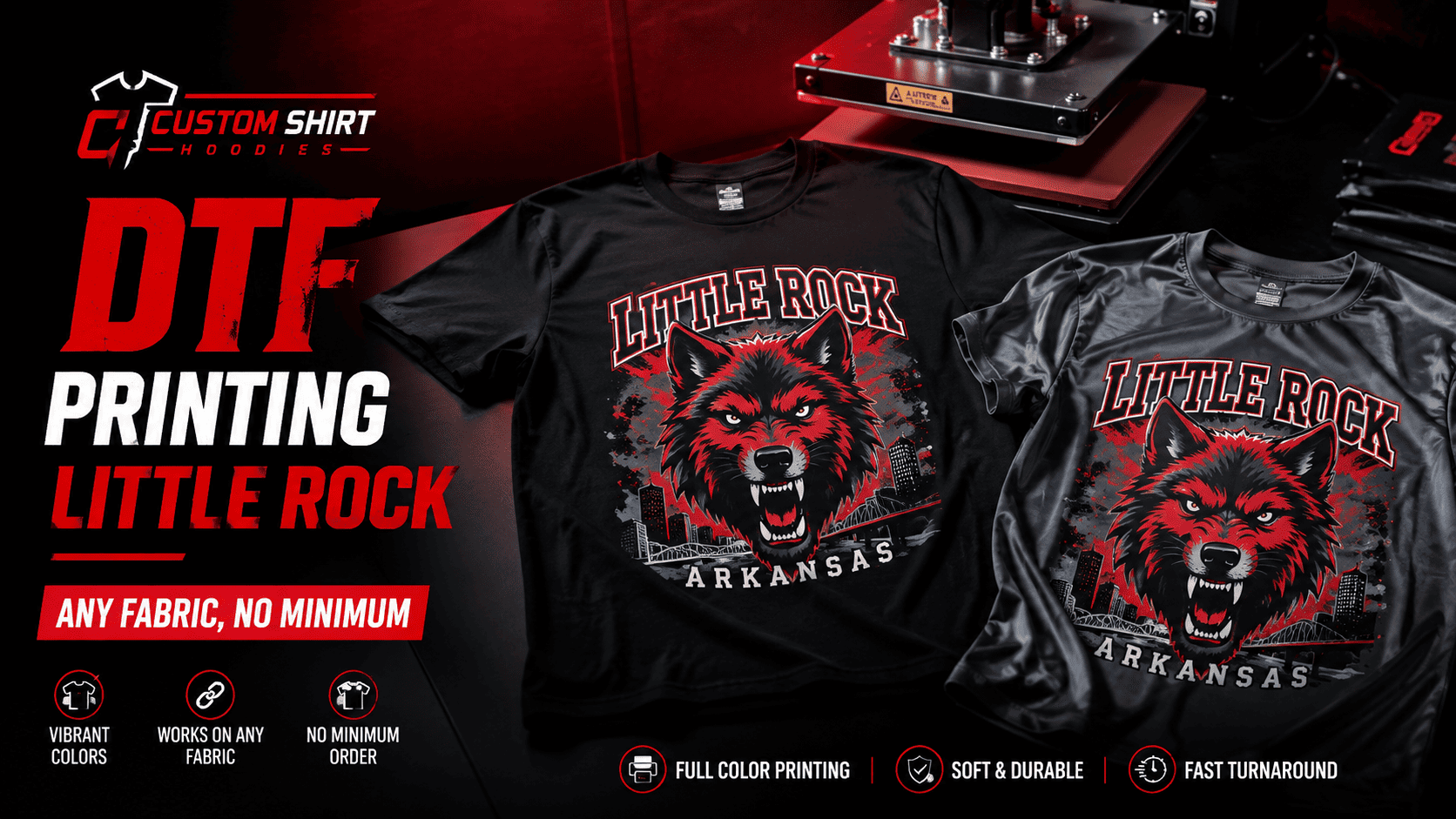
DTF Printing Little Rock, One Method for Almost Any Fabric
Most printing methods have a fabric they do not handle well. Screen printing struggles with stretch fabric. DTG needs mostly cotton to look right. DTF was built to get around that limit.
DTF stands for direct to film. The design prints onto a film sheet first, then transfers onto the garment with heat and pressure. Because the transfer bonds to the surface rather than soaking into the fibers, it works across cotton, polyester, blends, and even some non-fabric items like bags and hats.
This covers how DTF printing works, where it beats other methods, what it costs to run, and where to get DTF printing Little Rock shops handle in-house.
Quick Summary
DTF printing prints a design onto film, then heat-transfers it onto the garment. It works on cotton, polyester, and blends without changing the process, which makes it the most flexible method for mixed-fabric orders. Custom shirt hoodies run DTF printing. Little Rock orders in-house near Park Plaza alongside screen printing and DTG.
How DTF Printing Actually Works
The process runs in four steps. The design prints onto a clear film using specialized ink. A white layer goes down first if the design needs to show on a dark garment. An adhesive powder gets applied and cured over the ink. Then the film gets pressed onto the garment with a heat press, which melts the adhesive and bonds the design to the fabric.
Once the transfer cools, the film backing peels away and the design stays on the garment. Nothing about the fabric underneath affects this process, which is the reason DTF handles so many different materials without switching equipment or ink.
DTF Printing vs DTG
Both methods print full color without screens or a minimum order. The difference is what they print onto and where the ink ends up.
DTG sprays ink directly into the fabric fibers, so it needs a fabric that absorbs ink well. Cotton is the standard. On polyester, DTG ink does not bond the same way, and the print can look faded or wash out early.
DTF sidesteps that problem completely. Since the design transfers as a finished layer rather than soaking into the material, fabric type stops being a limiting factor. A DTF print on cotton and a DTF print on polyester go through the exact same process and hold the same way.
The trade-off is feel. DTG sits inside the fabric, so it feels soft, almost like the print is part of the shirt. DTF sits on top, so a large print has a slight texture you can feel with your fingers. For most designs that texture is minor, but it is worth knowing before ordering a large full-front graphic.
DTF Printing vs Screen Printing
Screen printing needs a fabric that pushes ink through cleanly and holds a shape. It works best on cotton and cotton blends and struggles with stretchy performance fabric, where the ink can crack as the fabric moves.
DTF handles stretch fabric without that problem, since the transfer flexes along with the garment instead of sitting rigid on the surface. For athletic wear, performance polyester, and any blend with spandex, DTF is usually the safer choice.
Screen printing still wins on large bulk orders. The setup cost is fixed per color, so a big run of the same design gets cheaper per piece as the quantity grows. DTF pricing stays closer to flat per piece regardless of quantity, since each transfer is printed and pressed individually. A closer look at DTF vs screen printing breaks down where each one wins on cost and durability. For a full comparison across methods, screen printing in Little Rock covers how the bulk pricing works.
What DTF Printing Handles Well
A few situations consistently point toward DTF over other methods.
Mixed fabric orders. A batch with some cotton shirts and some polyester jerseys can run through DTF without changing the process for either.
Small and single orders. No minimum, since each transfer is made individually. One shirt is a complete order, same as with DTG printing.
Detailed, full-color designs. DTF holds fine detail and gradient color as well as DTG, without the fabric restrictions.
Dark garments. The white underbase layer prints as part of the transfer, so colors show clearly on black, navy, and other dark fabric.
Non-standard items. Hats, bags, and other items that are not flat t-shirt fabric can often take a DTF transfer where other methods cannot reach.
What DTF Printing Costs
Pricing depends on the size of the transfer, the number of colors, and the quantity. A small chest-size design costs less than a full-front or full-back print, since more film and ink go into a larger transfer.
Unlike screen printing, DTF does not drop sharply in price at higher quantities, because there is no shared setup cost to spread across a run. What a single shirt costs is close to what shirt twenty costs on a per-piece basis. That makes DTF less competitive than screen printing for very large identical runs, and more competitive for smaller or mixed orders.
For a general breakdown of pricing across methods, how much t-shirt printing costs covers the ranges buyers should expect before walking in.
Caring for a DTF Print
A DTF transfer holds up well through normal washing when handled correctly. Turn the garment inside out before washing, use cold water, and skip the dryer’s high heat setting. Air drying or a low tumble dry extends the life of the print.
Ironing directly over a DTF design can soften the adhesive and cause it to lift, so iron around the print or place a cloth over it if pressing the garment. A guide to caring for embroidered or DTF printed garments covers wash and dry settings in more detail. Followed correctly, these steps keep a DTF print looking sharp for years of regular wear.
Choosing Between DTF, DTG, and Screen Printing
| Factor | DTF | DTG | Screen Printing |
| Fabric range | Cotton, polyester, blends | Best on cotton | Best on cotton and blends |
| Minimum order | None | None | Usually 12+ |
| Bulk pricing | Stays flat | Stays flat | Drops sharply |
| Feel | Slight texture | Soft, in the fabric | Slightly raised |
| Dark garments | Strong, built-in white base | Needs underbase, added step | Strong with white ink |
| Best for | Mixed fabric, small runs | Cotton, detailed art | Large identical runs |
For anyone unsure which method fits a specific order, best printing method for t-shirts walks through the decision in more detail.
What to Bring for a DTF Printing Order
Having these ready speeds up the process. Bring the design file, ideally vector or a high-resolution image. Know the garment type and fabric, since that confirms DTF is the right call. Decide on placement, whether that is chest, full front, back, or sleeve. Have sizes and quantity ready if it is a group order. State the deadline up front so the shop can plan around it.
If the order includes a mix of cotton and polyester garments, mention that clearly. It is one of the clearest signals that DTF is the better fit over DTG or screen printing.
Getting DTF Printing Little Rock Orders Right
DTF printing needs the right equipment and a careful hand with the heat press, since pressing too hot or too long can affect how the transfer bonds. Custom Shirt Hoodies runs it in-house near Park Plaza alongside screen printing, DTG, and embroidery, so the shop can recommend the right method rather than fitting every order into one process.
You see the design before it transfers, and you check the finished garment before you pay. For bulk orders across mixed fabric types, DTF often ends up the simplest way to keep one design consistent across the whole run.
Custom Shirt Hoodies serves Little Rock, North Little Rock, Sherwood, Conway, Benton, Bryant, Maumelle, Jacksonville, and Cabot. Walk in during business hours, or contact the team to plan a mixed-fabric or bulk order.
Key Takeaways
- DTF prints onto film first, then transfers onto the garment with heat, which is why fabric type barely matters.
- DTF handles cotton, polyester, and blends in the same process, unlike DTG or screen printing.
- No minimum order, so a single shirt is a normal job.
- Pricing stays close to flat per piece, which favors small and mixed orders over very large identical runs.
- Cold wash, inside out, low heat drying extends the life of a DTF print.
FAQs
What is DTF printing?
DTF stands for direct to film. The design prints onto a film sheet with special ink, an adhesive powder is applied and cured, and the film is pressed onto the garment with heat. The design transfers as a bonded layer rather than soaking into the fabric.
Is DTF printing better than DTG?
Neither is better overall. DTF works across more fabric types, including polyester and blends. DTG feels softer on cotton since the ink sits inside the fibers rather than on top. The right choice depends on the fabric and the design.
Can DTF printing be used on polyester?
Yes. DTF is one of the few methods that prints reliably on polyester and blended fabric, since the transfer bonds to the surface rather than depending on the fabric to absorb ink the way DTG does.
How much does DTF printing cost?
Cost depends on the size of the transfer, the number of colors, and the quantity. Pricing stays close to flat per piece rather than dropping sharply at higher quantities, which makes DTF more cost-effective for smaller or mixed-fabric orders than for very large identical runs.
Is there a minimum order for DTF printing?
No. Each transfer is printed and pressed individually, so a single garment is a complete order, the same as DTG.