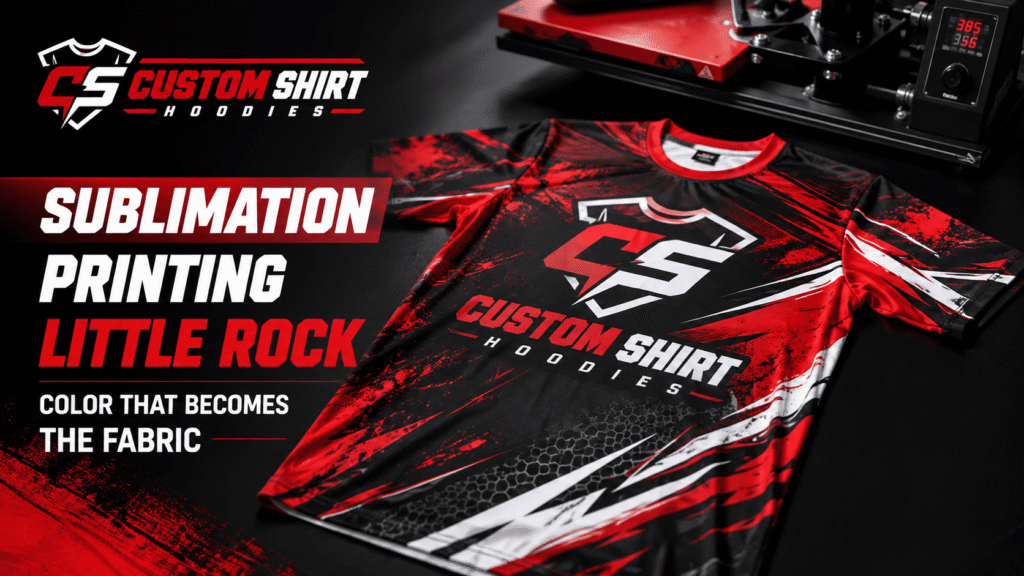
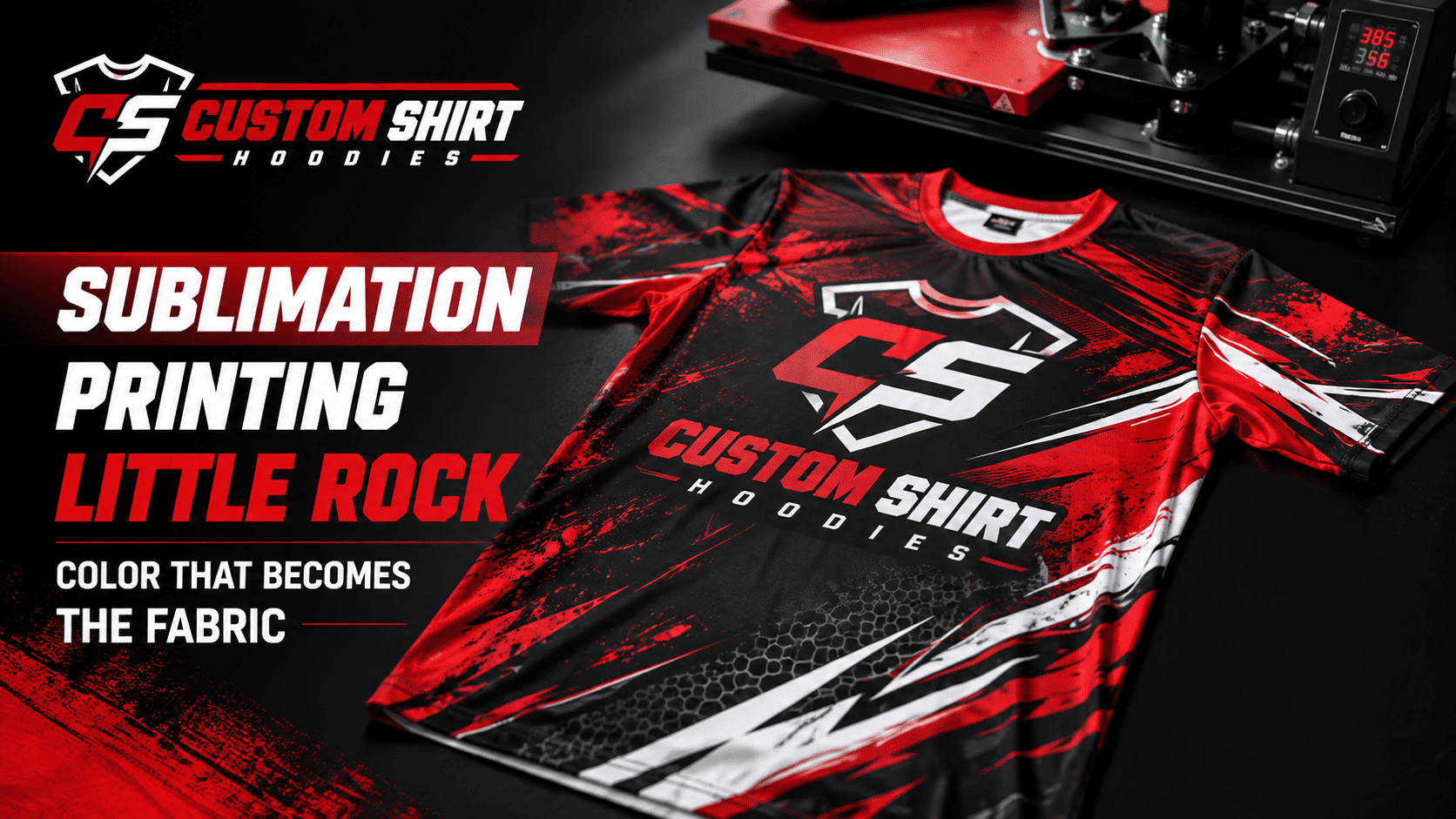
Sublimation Printing Little Rock, Full-Color, Edge to Edge
Most printing methods put color on top of a shirt. Sublimation puts color inside it. That difference sounds small until you see what it allows on the finished garment.
Sublimation turns solid dye into a gas under heat, and that gas bonds directly into the fibers of the fabric. Nothing sits on the surface to crack, peel, or fade the way ink from other methods can. The design becomes part of the shirt rather than a layer applied to it.
This covers how sublimation printing works, why it needs polyester, where it beats other methods, and where to get sublimation printing Little Rock shops handle in-house.
Quick Summary
Sublimation printing turns dye into a gas under heat and pressure, and that gas bonds permanently into polyester fibers. The result is full-color, edge-to-edge printing with no cracking or peeling, though it only works on polyester or high-poly-blend fabric. Custom shirt hoodies run sublimation printing in Little Rock in-house near Park Plaza alongside screen printing, DTG, and DTF.
How Sublimation Printing Works
The process starts with a design printed onto special transfer paper using sublimation ink. That paper gets pressed against the garment under a heat press set to a specific temperature.
At that temperature, the solid ink converts directly into a gas without passing through a liquid stage. The gas penetrates the fabric’s fibers and bonds there permanently as it cools back into a solid. This gas-phase transition is the defining feature of dye-sublimation printing, and it is what separates the method from every ink-based process. Once the paper peels away, the design is not sitting on the shirt. It is part of the shirt.
That bonding is why sublimation prints do not crack, peel, or fade the way surface-level prints can over time. There is no layer to wear away, since the color is inside the fiber itself.
Why Sublimation Only Works on Polyester
The gas-to-fiber bond that makes sublimation permanent only happens with polyester or a high-polyester blend. Cotton fibers do not accept the dye the same way, so a sublimation print on cotton fades or washes out quickly, if it takes at all.
This is the main limitation of the method. A design meant for a sublimation printing project needs a polyester garment from the start, not a cotton blank swapped in later. Most sublimation orders use 100% polyester shirts, or blends with at least 65% polyester content for a workable result.
For orders that mix fabric types, other methods handle the range better. DTF printing works across cotton, polyester, and blends without changing the process, which makes it the better fit when a group order includes different fabrics.
What Sublimation Printing Does Better Than Other Methods
Full-color, all-over designs are where sublimation has no real competition. Because the dye becomes part of the fabric rather than sitting on top, there is no visible print border, no texture change, and no limit on how much of the garment gets covered.
A design can run from collar to hem, wrap around the sides, and cover both sleeves in continuous color. Screen printing and DTG both print within a defined area on the garment. Sublimation removes that boundary entirely, which is why it is the standard method behind full-coverage sports jerseys and all-over graphic apparel.
Durability is the second advantage. Since nothing sits on the surface, there is nothing to crack or peel through repeated washing. A properly done sublimation print looks close to identical after years of normal wear, where a surface print can visibly degrade.
Sublimation Printing vs Screen Printing
Screen printing pushes ink through mesh screens and works well on cotton, with a fixed setup cost that gets cheaper per shirt as quantity increases. It handles bold, simple graphics on standard blanks efficiently.
Sublimation needs polyester and works best for full-coverage, complex, photographic designs rather than simple logos. Screen printing wins on large bulk orders of a bold design. Sublimation wins when the design needs to cover more of the garment than a standard print area allows, or when the fabric is already polyester for performance reasons. For a broader look across all the methods available, best printing method for t-shirts breaks down which one fits which order.
What Sublimation Printing Costs
Pricing depends on coverage area and garment type. A standard chest-size design costs less than a full all-over wrap, since more transfer paper, ink, and press time go into covering the entire shirt.
Because sublimation requires specific polyester blanks rather than standard cotton tees, the base garment cost tends to run higher than a plain cotton shirt used for screen printing or DTG. That cost difference is part of what buyers should expect before booking sublimation printing Little Rock orders. For general pricing ranges across methods, how much t-shirt printing costs covers what to budget for before ordering.
Sublimation Printing for Sports and Performance Wear
Sublimation is the standard behind most modern sports jerseys, and for a specific reason. Athletic performance fabric is almost always polyester, which happens to be exactly what sublimation needs to bond correctly.
The full-coverage capability lines up with how sports designs actually look, with color running across the whole jersey rather than staying in a boxed print area. The permanent bond also holds up to the repeated washing and physical wear that athletic apparel goes through.
Teams, leagues, and athletic programs ordering custom jerseys or full-print performance shirts are the most common sublimation customers, since the fabric and the method are naturally suited to each other. A closer breakdown of sublimation printing covers common jersey and apparel use cases in more depth.
What to Bring for a Sublimation Printing Order
Having the right information ready speeds up the process. Confirm the garment is polyester or a high-poly blend before deciding on sublimation, since the method will not hold on cotton. Bring the design file, ideally high resolution since the print can cover a large surface area. Decide on coverage, whether that is a chest design, full front, or complete all-over wrap. Have sizes and quantity ready for group or team orders. State the deadline clearly.
If the design includes photographic detail, gradients, or a background that needs to bleed off the edges of the garment, mention that directly. Those are the situations where sublimation printing earns its cost over a standard method.
Sublimation vs DTF vs DTG vs Screen Printing
| Factor | Sublimation | DTF | DTG | Screen Printing |
| Fabric | Polyester only | Cotton, poly, blends | Best on cotton | Best on cotton, blends |
| Coverage | Full garment, no borders | Defined print area | Defined print area | Defined print area |
| Durability | No cracking or peeling, ever | Very durable | Durable with care | Very durable |
| Feel | None, dyed into fiber | Slight surface texture | Soft, in the fabric | Slightly raised |
| Minimum order | None | None | None | Usually 12+ |
| Best for | All-over jerseys, full coverage | Mixed fabric orders | Cotton, detailed art | Large identical runs |
Key Takeaways
- Sublimation turns dye into a gas under heat, and the gas bonds permanently into polyester fibers.
- It only works on polyester or high-poly blends, unlike cotton-friendly methods.
- Full-garment, edge-to-edge color with no cracking or peeling is where sublimation has no real competitor.
- It costs more upfront due to specific polyester blanks, but the durability holds up over years of wear.
- Sports jerseys and performance wear are the most common use case, since athletic fabric is already polyester.
Getting Sublimation Printing Little Rock Orders Right
Sublimation printing needs the correct polyester blanks, accurate heat press timing, and dye sublimation ink that other equipment cannot substitute. Custom Shirt Hoodies runs it in-house near Park Plaza alongside screen printing, DTG, and DTF, so the right method gets matched to the right fabric instead of forcing every order through one process.
You see the design and confirm the garment before anything gets pressed, and you check the finished piece before you pay. For bulk orders like team jerseys or full-print event shirts, sublimation keeps the color consistent across every piece in the run.
Custom Shirt Hoodies serves Little Rock, North Little Rock, Sherwood, Conway, Benton, Bryant, Maumelle, Jacksonville, and Cabot. Walk in during business hours, or contact the team to plan a jersey run or full-coverage design.
Frequently Asked Questions
What is sublimation printing?
Sublimation printing turns solid dye into a gas under heat and pressure, and that gas bonds directly into polyester fabric fibers. The design becomes part of the fabric rather than a layer sitting on top, which is why it does not crack or peel.
Can sublimation printing be used on cotton?
No. Sublimation only bonds correctly with polyester or a high-polyester blend. Cotton fibers do not accept the dye the same way, so a sublimation print on cotton fades quickly or does not hold at all.
Is sublimation printing better than DTF or DTG?
It depends on the fabric and design. Sublimation is unmatched for full-garment, all-over color on polyester. DTF and DTG work within a defined print area and handle a wider range of fabrics, including cotton.
How much does sublimation printing cost?
Cost depends on coverage area and garment type. Full all-over designs cost more than a standard chest print, and polyester blanks typically cost more than standard cotton tees used for other methods.
What is sublimation printing best used for?
Full-coverage sports jerseys and performance wear are the most common use, since athletic polyester fabric is exactly what the process needs. It also suits any design that needs to run edge to edge across the garment without a visible print border.